




Many sporty people focus on their muscles: strengthening them, stretching them, letting them recover. Their joints, on the other hand, often take a back seat… until the day they start to hurt.
That is the fundamental mistake: treating joints as simple passive hinges, when in fact they are living structures that need just as much attention as the muscles.
Signals that come without warning
The problem is that these signals do not appear straight away. For months, or even years, the joints quietly compensate.
Running, fitness, tennis, hiking: they absorb thousands of tiny impacts every week without complaint. Then the first discomforts appear: sensitive knees, morning stiffness, clicking shoulders, discomfort after exercise.
At this stage, many people cut back on their activity, when they should have taken better care of their joints much earlier.
DID YOU KNOW?
Joint cartilage is one of the few tissues in the body that has no blood supply: it receives its nutrients solely by diffusion from the synovial fluid. That is why it regenerates slowly, and why protecting it matters all the more.

To keep your joints in top shape, avoid these 4 mistakes
1. Skipping the joint warm-up
A cold joint behaves very differently from one with a good blood supply. Synovial fluid, the natural lubricant that protects the cartilage, only spreads properly after several minutes of gradual, circular movements.
Starting an intense effort without this phase is like revving a cold engine at full throttle: it wears, and it wears fast.
2. Confusing pain with muscle discomfort
A slight tension during exercise can be normal. Joint discomfort, however, is almost always a signal to heed immediately. Many sporty people carry on despite a clicking knee or a burning ankle, convinced it will pass. This is often how minor injuries become chronic.
3. Putting up with repetitive loads
Always running on the same surface, swimming with the same technique, lifting along the same axis: joints cope badly with identical repetition. Varying surfaces, angles and intensities is not a luxury, it is a necessity.
4. Neglecting the muscles around the joints
The muscles that surround a joint are its first line of protection: they absorb shocks, stabilise it and compensate for mechanical imbalances. Ignoring this stabilising work exposes the cartilage and ligaments to stresses they are not designed to absorb on their own.
The role of food supplements
Experienced athletes know it: lasting performance depends as much on recovery as on training. Some athletes also supplement their diet with food supplements, which are not a substitute for a varied and balanced diet and a healthy lifestyle.
Collagen
Collagen is the structural protein that gives joints their strength and elasticity, and the main component of cartilage, tendons and ligaments.
Hydrolysed collagen comes in powder or capsule form.
Glucosamine and chondroitin
They are often combined in the same formula.
IN PRACTICE
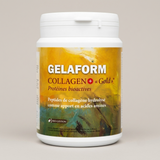
GELAFORM Collagen+ Gold, hydrolysed collagen, soluble powder, to be dissolved in orange or acerola juice.
Move for longer, move well
The real goal of sport should not be to “get through” today, but to preserve your mobility for the years to come. Looking after your joints before discomfort sets in often means you can keep moving for longer, with more comfort and fewer limitations.
Because, in the end, moving without discomfort is the finest performance of all.


